LAPTOPS


A laptop is a personal computer designed for mobile use and small and light enough to sit on one's lap while in use.A laptop integrates most of the typical components of a desktop computer, including a display, a keyboard, a pointing device (a touchpad, also known as a trackpad, and/or a pointing stick), speakers, and often including a battery, into a single small and light unit. The rechargeable battery (if present) is charged from an AC adapter and typically stores enough energy to run the laptop for two to three hours in its initial state, depending on the configuration and power management of the computer.


Laptops are usually shaped like a large notebook with thicknesses between 0.7–1.5 inches (18–38 mm) and dimensions ranging from 10x8 inches (27x22cm, 13" display) to 15x11 inches (39x28cm, 17" display) and up. Modern laptops weigh 3 to 12 pounds (1.4 to 5.4 kg); older laptops were usually heavier. Most laptops are designed in the flip form factor to protect the screen and the keyboard when closed. Modern tablet laptops have a complex joint between the keyboard housing and the display, permitting the display panel to swivel and then lie flat on the keyboard housing. They usually have a touchscreen display and some include handwriting recognition or graphics drawing capability.


Laptops were originally considered to be "a small niche market" and were thought suitable mostly for "specialized field applications" such as "the military, the Internal Revenue Service, accountants and sales representatives". But today, there are already more laptops than desktops in businesses, and laptops are becoming obligatory for student use and more popular for general use. In 2008 more laptops than desktops were sold in the US and it has been predicted that the same milestone will be reached in the worldwide market as soon as late 2009.


History


As the personal computer became feasible in the early 1970s, the idea of a portable personal computer followed. A "personal, portable information manipulator" was imagined by Alan Kay at Xerox PARC in 1968 and described in his 1972 paper as the "Dynabook".


The IBM SCAMP project (Special Computer APL Machine Portable), was demonstrated in 1973. This prototype was based on the PALM processor (Put All Logic In Microcode).


The IBM 5100, the first commercially available portable computer, appeared in September 1975, and was based on the SCAMP prototype.


As 8-bit CPU machines became widely accepted, the number of portables increased rapidly. The Osborne 1, released in 1981, used the Zilog Z80 and weighed 23.5 pounds (10.7 kg). It had no battery, a 5" CRT screen and dual 5¼" single-density floppy drives. In the same year the first laptop-sized portable computer, the Epson HX-20, was announced. The Epson had a LCD screen, a rechargeable battery and a calculator-size printer in a 1.6 kg (3.5 lb) chassis. Both Tandy/RadioShack and HP also produced portable computers of varying designs during this period.


The first laptop using the flip form factor appeared in 1982. The $8150 GRiD Compass 1100 was used at NASA and by the military among others. The Gavilan SC, released in 1983, was the first notebook marketed using the term "laptop". From 1983 onwards, several new input techniques were developed and included in laptops, including the touchpad (Gavilan SC, 1983), the pointing stick (IBM ThinkPad 700, 1992) and handwriting recognition (Linus Write-Top, 1987). Some CPUs were designed specifically for low power use including laptops (Intel i386SL, 1990), and were supported by dynamic power management features (Intel SpeedStep and AMD PowerNow!) in some designs. Displays reached VGA resolution by 1988 (Compaq SLT/286) and 256-color screens by 1993 (PowerBook 165c), progressing quickly to millions of colors and high resolutions.


High-capacity hard drives and optical storage (CD-ROM followed by CD-R and CD-RW and eventually by DVD-ROM and the writable varieties) became available in laptops soon after their introduction to the desktops.

Subnotebook


File:Sonyvaiosub1.jpg


A subnotebook, also called an ultraportable by some vendors, is a laptop designed and marketed with an emphasis on portability (small size, low weight and longer battery life) that retains the performance of a standard notebook.Subnotebooks are usually smaller and lighter than standard laptops, weighing between 0.8 and 2 kg (2 to 5 pounds); the battery life can exceed 10 hour when a large battery or an additional battery pack is installed.

To achieve the size and weight reductions, ultraportables use high resolution 13" and smaller screens (down to 6.4"), have relatively few ports, employ expensive components designed for minimal size and best power efficiency, and utilize advanced materials and construction methods. Some subnotebooks achieve a further portability improvement by omitting an optical/removable media drive; in this case they may be paired with a docking station that contains the drive and optionally more ports or an additional battery.


Netbook


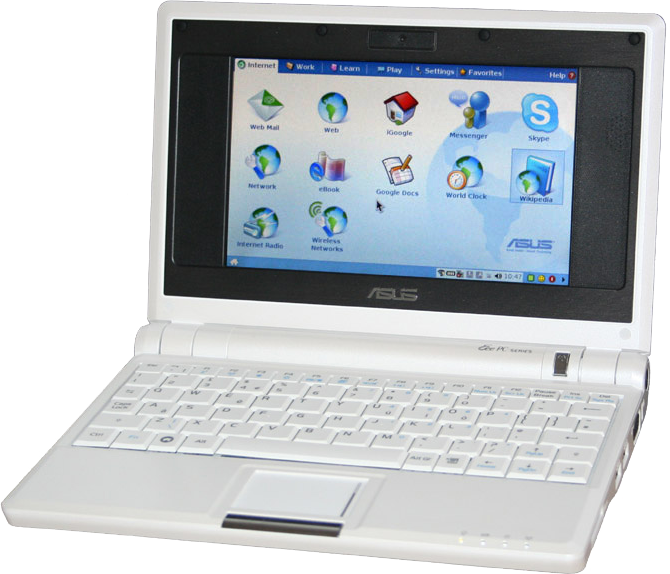
File:ASUS Eee White Alt-small.png


Netbooks are laptops that are light-weight, economical, energy-efficient and especially suited for wireless communication and Internet access. Hence the name netbook (as "the device excels in web-based computing performance") rather than notebook which pertains to size.

Especially suited for web browsing and e-mailing, netbooks "rely heavily on the Internet for remote access to web-based applications". and are targeted increasingly at cloud computing users who rely on servers and require a less powerful client computer. While the devices range in size from below 5 inches to over 12,most are between 7 and 11 inches and weigh between 2 and 3 pounds.

Netbooks normally use light-weight operating systems including Linux and Windows XP rather than more resource-intensive operating systems like Windows Vista, as they have less processing power than traditional laptops.

Recently, Google has announced to be developing an own operating system called Chrome for this market.

Rugged laptop


File:Toughbook-cf-m34 4.jpg


A rugged (or ruggedized) laptop is designed to reliably operate in harsh usage conditions such as strong vibrations, extreme temperatures, and wet or dusty environments. Rugged laptops are usually designed from scratch, rather than adapted from regular consumer laptop models. Rugged notebooks are bulkier, heavier, and much more expensive than regular laptops, and thus are seldom seen in regular consumer use.

The design features found in rugged laptops include rubber sheeting under the keyboard keys, sealed port and connector covers, passive cooling, superbright displays easily readable in daylight, cases and frames made of magnesium alloys that are much stronger than plastic found in commercial laptops, and solid-state storage devices or hard disc drives that are shock mounted to withstand constant vibrations. Rugged laptops are commonly used by public safety services (police, fire and medical emergency), military, utilities, field service technicians, construction, mining and oil drilling personnel. Rugged laptops are usually sold to organizations, rather than individuals, and are rarely marketed via retail channels.

The term "subnotebook" is usually reserved to laptops that run general-purpose desktop operating systems such as Windows, Linux or Mac OS X, rather than specialized software such as Windows CE, Palm OS or Internet Tablet OS.

Monday, October 26, 2009

HP's new fall collection includes new designer series ultraportables and the HP Envy 15, HP's most powerful laptop ever. Check out all the new HP laptops here.

HP today took the wraps off a slew of new machines for the upcoming 2009 Holiday season, including some new ultraportable machines, a couple inexpensive business and multimedia laptops and even a pair of new HP Envy laptops to fill out the high-end. Some of these are available now, but most will become available at the end of October, when Windows 7 hits the market and a slew of new devices start taking advantage of Microsoft's new Windows OS.


Envy, with a little less Voodoo

At the high end, HP today released what the company is calling the "fastest consumer notebook" that it has ever made. The HP Envy 15 is a 1-inch thick, 5.18-pound system, clearly reminiscent of Apple's high-end Macbook Pro machines. The new Envy 15 will use Intel Core 2 Duo processors, up to the new Core i7 processor that's just starting to drain batteries in laptops across the globe. That's just the top of the Envy 15's high-end specs. The thin new performance machine will also use an ATI Mobility Redeon HD 4830 card for graphics, with a full 1GB of extra memory for the video processor. This will help the machine drive DirectX 10.1 graphics on Windows 7.

The new machine will also support up to 16GB of DDR3 RAM. The 15.6-inch display will come in a couple configurations, including an LED backlit display with Full HD support and a light output of 300-nits. On the inside, you can fill the HP Envy 15 with 2 separate solid state drives (SSDs), running in Raid0 configuration for improved performatnce. The HP Envy 15 even gets a cool webcam, an HP model that can record in zero-light with the help of an infrared LED built-in.

The smaller of the two HP Envy laptops, the HP Envy 13, won't get the full performance of it's larger sibling, but it will still retain a high-end feature set, along with the etched metal look that defines this generation of HP Envy machines. HP may have dropped the Voodoo moniker from these flagship notebooks, but they still get a stylish enhancement as HP's first two etched metal machines. The HP Envy 15 will get an etched design on the lid and near the trackpad, while the Envy 13 gets an etched trackpad only.

Even with its smaller stature, the HP Envy 13 is nothing to sneeze at. The 13-inch display will be the brightest in its class, according to HP, with a 410-nit output and the ability to run 82% of the color gamut. The HP Envy 13 is less than 1-inch thick, at 3.74 pounds of aluminum and magnesium shell. For graphics, the HP Envy 13 will get a switchable configuration from ATI. The device will use the ATI Mobility Radeon HD 4330 card when performance is key, then scale back to Intel integrated graphics to save power.

Both notebooks will have an HP Extended-Life Notebook Battery available. The HP Envy 13 will get up to 18 hours of life out of the extended-life battery. The larger, higher-performance HP Envy 15 will get up to 7 hours of use out of the extended-life battery.

Mini, now with more style and ION power

The HP Mini lineup also got an interesting boost with today's announcements. HP today unveiled the new HP Mini 311, the company's first NVIDIA ION powered ultraportable notebook. The combination of Intel Atom processor and NVIDIA Ion LE graphics should provide enough of a graphical boost to let the new HP Mini 311 display high-definition content either on its own screen or an external display. The Mini 311's screen is a pixel-packed 1366 by 768 resolution monitor, capable of 720p videos. The device also comes with an HDMI output to show videos up to 1080p on an external HDTV.

The HP Mini 311 uses an 11.6-inch display, slightly larger than the 10-inch screens on the HP Mini 110 device. The ultraportable otherwise keeps the same basic look and feel of HP's smaller notebooks, with rounded corners and an imprinted design on the lid. Like other HP netbooks, the HP Mini 311 also uses a keyboard that is 92% as large as a full-sized notebook keyboard.

The HP Mini 110 also gets a stylish update for the fall season. The Mini 110 is now being customized by Studio Tord Boontje. The design studio has added an HP Imprint 3-D surface, which layers multiple surface layers to create a 3-D effect on the diminutive ultraportable's shell. HP is calling this a first. The device still uses a 10.1-inch display, though it seems the screen will now be displaying custom desktop themes and wallpapers, also from the Tord Boontje studio. The Mini 110 will also come in a box that is made from 100% recycled materials, with manuals printed using water- or soy-based inks.

Both new HP Mini computers are available now for pre-order, and both will ship at the end of October, to coincide with the launch of Windows 7. Both will be available for $400.

When the going gets tough, the Pros get aluminum

To round out their notebook offerings, HP also refreshed the mid-range for their prosumer and multimedia families. The new HP ProBook 5310m strongly resembles a slightly larger version of the company's HP 5101, but this notebook is aimed more at the performance-minded business user. To that end, unlike the unltraportable model, the HP ProBook 5310m will be available with a full-powered, Intel Core 2 Duo processor, though ultra-low voltage Celeron options will also be available. HP claims the ProBook 5310m is the "thinnest full-performance notebook," measuring under 1-inch and weighing less than 4 pounts.

The HP ProBook 5310m uses a 13.3-inch LED-backlit display, capable of showing high-definition video content. The machine is clad in a black anodized aluminum frame with a magnesium chassis, coated in a soft touch paint. The professional HP ProBook 5310m gets up to 7 hours of battery life with the standard battery, and HP says an extended-life battery will be available later in the year.

The HP ProBook 5310m will also be available with the Qualcomm Gobi chip, a mult-network integrated WWAN chip that lets users surf the internet wireless on cellular networks. That's a great option for business users, but all of these powerful options are sure to drive up the price for this machine. The HP ProBook 5310m will ship for $700 with a Celeron chip, and will start at $900 for an Intel Core 2 Duo processor, with custom options adding to that price.

For multimedia fans, HP has also updated their HP Pavilion family with the new HP Pavilion dm3, a thinner multimedia notebook that uses an aluminum frame. Like the ProBook, the new HP Pavilion dm3 will use a 13.3-inch display, and the laptop will measure 1-inch thick, and weigh just over 4 pounds. With a standard 6-cell battery, the new HP Pavilion dm3 will get up to 10 hours of battery life, or so HP claims.

HP will have a number of graphics options available for the HP Pavilion dm3, and buyers will be able to mix and match AMD or Intel processors. Using an AMD processor with an ATI graphics card, users will be able to select a performance option or a shared graphics option that uses integrated graphics to save power while the machine is running on battery life.

The HP Pavilion dm3 won't have a built-in drive, but there will be an optional external drive available from HP, including an external with a Blu-Ray player. Like the ProBook 5310m, the HP Pavilion dm3 will also have an option to add WWAN for data over cellular networks. The Pavilion dm3 will ship on October 22, the day Windows 7 ships, with a starting price of $550 for an AMD-powered unit, or $650 for an Intel-powered device.

No comments:

Post a Comment