LAPTOPS A laptop is a personal computer designed for mobile use and small and light enough to sit on one's lap while in use.A laptop integrates most of the typical components of a desktop computer, including a display, a keyboard, a pointing device (a touchpad, also known as a trackpad, and/or a pointing stick), speakers, and often including a battery, into a single small and light unit. The rechargeable battery (if present) is charged from an AC adapter and typically stores enough energy to run the laptop for two to three hours in its initial state, depending on the configuration and power management of the computer.
Laptops are usually shaped like a large notebook with thicknesses between 0.7–1.5 inches (18–38 mm) and dimensions ranging from 10x8 inches (27x22cm, 13" display) to 15x11 inches (39x28cm, 17" display) and up. Modern laptops weigh 3 to 12 pounds (1.4 to 5.4 kg); older laptops were usually heavier. Most laptops are designed in the flip form factor to protect the screen and the keyboard when closed. Modern tablet laptops have a complex joint between the keyboard housing and the display, permitting the display panel to swivel and then lie flat on the keyboard housing. They usually have a touchscreen display and some include handwriting recognition or graphics drawing capability.
Laptops were originally considered to be "a small niche market" and were thought suitable mostly for "specialized field applications" such as "the military, the Internal Revenue Service, accountants and sales representatives". But today, there are already more laptops than desktops in businesses, and laptops are becoming obligatory for student use and more popular for general use. In 2008 more laptops than desktops were sold in the US and it has been predicted that the same milestone will be reached in the worldwide market as soon as late 2009.
HistoryAs the personal computer became feasible in the early 1970s, the idea of a portable personal computer followed. A "personal, portable information manipulator" was imagined by Alan Kay at Xerox PARC in 1968 and described in his 1972 paper as the "Dynabook".
The IBM SCAMP project (Special Computer APL Machine Portable), was demonstrated in 1973. This prototype was based on the PALM processor (Put All Logic In Microcode).
The IBM 5100, the first commercially available portable computer, appeared in September 1975, and was based on the SCAMP prototype.
As 8-bit CPU machines became widely accepted, the number of portables increased rapidly. The Osborne 1, released in 1981, used the Zilog Z80 and weighed 23.5 pounds (10.7 kg). It had no battery, a 5" CRT screen and dual 5¼" single-density floppy drives. In the same year the first laptop-sized portable computer, the Epson HX-20, was announced. The Epson had a LCD screen, a rechargeable battery and a calculator-size printer in a 1.6 kg (3.5 lb) chassis. Both Tandy/RadioShack and HP also produced portable computers of varying designs during this period.
The first laptop using the flip form factor appeared in 1982. The $8150 GRiD Compass 1100 was used at NASA and by the military among others. The Gavilan SC, released in 1983, was the first notebook marketed using the term "laptop". From 1983 onwards, several new input techniques were developed and included in laptops, including the touchpad (Gavilan SC, 1983), the pointing stick (IBM ThinkPad 700, 1992) and handwriting recognition (Linus Write-Top, 1987). Some CPUs were designed specifically for low power use including laptops (Intel i386SL, 1990), and were supported by dynamic power management features (Intel SpeedStep and AMD PowerNow!) in some designs. Displays reached VGA resolution by 1988 (Compaq SLT/286) and 256-color screens by 1993 (PowerBook 165c), progressing quickly to millions of colors and high resolutions.
High-capacity hard drives and optical storage (CD-ROM followed by CD-R and CD-RW and eventually by DVD-ROM and the writable varieties) became available in laptops soon after their introduction to the desktops.
Subnotebook
A subnotebook, also called an ultraportable by some vendors, is a laptop designed and marketed with an emphasis on portability (small size, low weight and longer battery life) that retains the performance of a standard notebook.Subnotebooks are usually smaller and lighter than standard laptops, weighing between 0.8 and 2 kg (2 to 5 pounds); the battery life can exceed 10 hour when a large battery or an additional battery pack is installed.
To achieve the size and weight reductions, ultraportables use high resolution 13" and smaller screens (down to 6.4"), have relatively few ports, employ expensive components designed for minimal size and best power efficiency, and utilize advanced materials and construction methods. Some subnotebooks achieve a further portability improvement by omitting an optical/removable media drive; in this case they may be paired with a docking station that contains the drive and optionally more ports or an additional battery.
Netbook
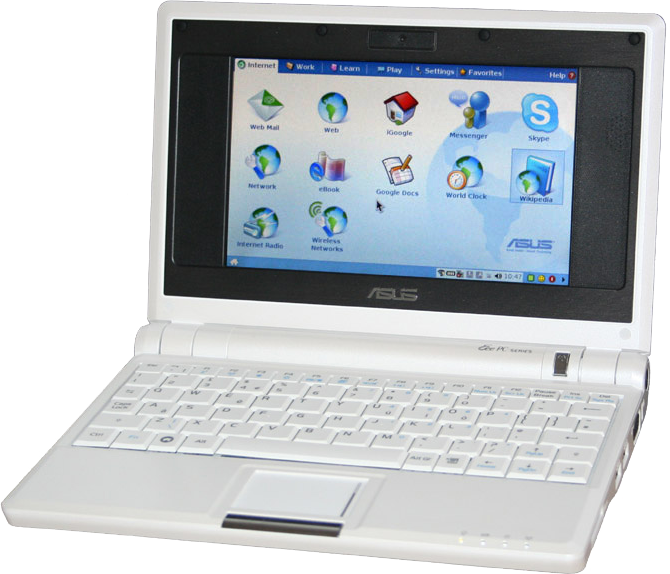
Netbooks are laptops that are light-weight, economical, energy-efficient and especially suited for wireless communication and Internet access. Hence the name netbook (as "the device excels in web-based computing performance") rather than notebook which pertains to size.
Especially suited for web browsing and e-mailing, netbooks "rely heavily on the Internet for remote access to web-based applications". and are targeted increasingly at cloud computing users who rely on servers and require a less powerful client computer. While the devices range in size from below 5 inches to over 12,most are between 7 and 11 inches and weigh between 2 and 3 pounds.
Netbooks normally use light-weight operating systems including Linux and Windows XP rather than more resource-intensive operating systems like Windows Vista, as they have less processing power than traditional laptops.
Recently, Google has announced to be developing an own operating system called Chrome for this market.
Rugged laptop
A rugged (or ruggedized) laptop is designed to reliably operate in harsh usage conditions such as strong vibrations, extreme temperatures, and wet or dusty environments. Rugged laptops are usually designed from scratch, rather than adapted from regular consumer laptop models. Rugged notebooks are bulkier, heavier, and much more expensive than regular laptops, and thus are seldom seen in regular consumer use.
The design features found in rugged laptops include rubber sheeting under the keyboard keys, sealed port and connector covers, passive cooling, superbright displays easily readable in daylight, cases and frames made of magnesium alloys that are much stronger than plastic found in commercial laptops, and solid-state storage devices or hard disc drives that are shock mounted to withstand constant vibrations. Rugged laptops are commonly used by public safety services (police, fire and medical emergency), military, utilities, field service technicians, construction, mining and oil drilling personnel. Rugged laptops are usually sold to organizations, rather than individuals, and are rarely marketed via retail channels.
The term "subnotebook" is usually reserved to laptops that run general-purpose desktop operating systems such as Windows, Linux or Mac OS X, rather than specialized software such as Windows CE, Palm OS or Internet Tablet OS.




No comments:
Post a Comment